Beginner running plan: 0 to 30 minutes in 8 weeks
Most new runners quit for one of two reasons: it feels awful, or something starts to hurt. This plan fixes both. You run slowly, you walk often, and you build up over eight weeks to 30 minutes without stopping.
Run three times a week, never two days in a row. Start with 1 minute of easy running and 2 minutes of brisk walking, repeated 8 times, and add a little running each week. By week 8 you run 30 minutes non-stop. Run slowly enough to talk in full sentences, and repeat any week that felt hard.
The 8-week plan
Every run starts with a 5-minute brisk walk and ends with a 5-minute walk. The total time stays about the same; what grows is how much of it you run.
| Week | Each of your three runs | Running time |
|---|---|---|
| 1 | Run 1 min, walk 2 min, × 8 | 8 min |
| 2 | Run 2 min, walk 2 min, × 6 | 12 min |
| 3 | Run 3 min, walk 2 min, × 5 | 15 min |
| 4 | Run 4 min, walk 1½ min, × 5 | 20 min |
| 5 | Run 6 min, walk 1½ min, × 4 | 24 min |
| 6 | Run 10 min, walk 2, run 10 min, walk 2, run 6 min | 26 min |
| 7 | Run 15 min, walk 2 min, run 12 min | 27 min |
| 8 | Run 1: 20 min, walk 2, run 8 · Run 2: 25 min non-stop · Run 3: 30 min non-stop | 30 min |
Start with two weeks of brisk walking, 30 minutes three times a week, then begin week 1. That is a strong start, not a slow one.
The five rules that make it work
- Three runs a week, never two days in a rowRest days are when your body adapts. Walking, cycling or swimming on them is fine.
- Run slowly enough to talkFull sentences, not a few gasped words. If you cannot talk, slow down or walk until you can. It will feel almost too slow. That is right.
- Repeat any week that felt hardIf you could not finish a run, or it felt harder than about 5 out of 10, do the week again. Most people repeat at least one week.
- Missed a week? Go back oneMissed two or more weeks? Go back two. If you were ill with a fever or chest symptoms, rest until it clears, then restart a week back.
- Do not jump aheadEven when a week feels easy. Your heart and lungs adapt quickly; your tendons and bones take longer, and that is where beginner injuries happen.
Why walking breaks are not cheating
Run/walk is how almost every beginner plan works. The walking lets your heart, lungs, muscles and tendons adapt together. By week 8 the walking is gone, and you got there without the shin pain that stops so many people in week three.
A 2025 study followed 5,205 runners for 18 months. A single run 10–30% longer than the longest run in the previous 30 days was linked to a 64% higher injury rate. Runs more than twice as long more than doubled it. Changes in weekly totals showed no clear link.
So the one number to watch is your longest single run. Before any run longer than usual, check your longest run of the last 30 days and stay within about 10% of it. This plan already does that for you.
How it should feel
| Effort (out of 10) | Feels like | Talk test |
|---|---|---|
| 1–2 | Very easy | Easy chat |
| 3–4 | Easy and steady. Most of your running. | Full sentences |
| 5–6 | Moderate, breathing harder | Short sentences |
| 7–8 | Hard | A few words. Not in this plan |
Simple form cues
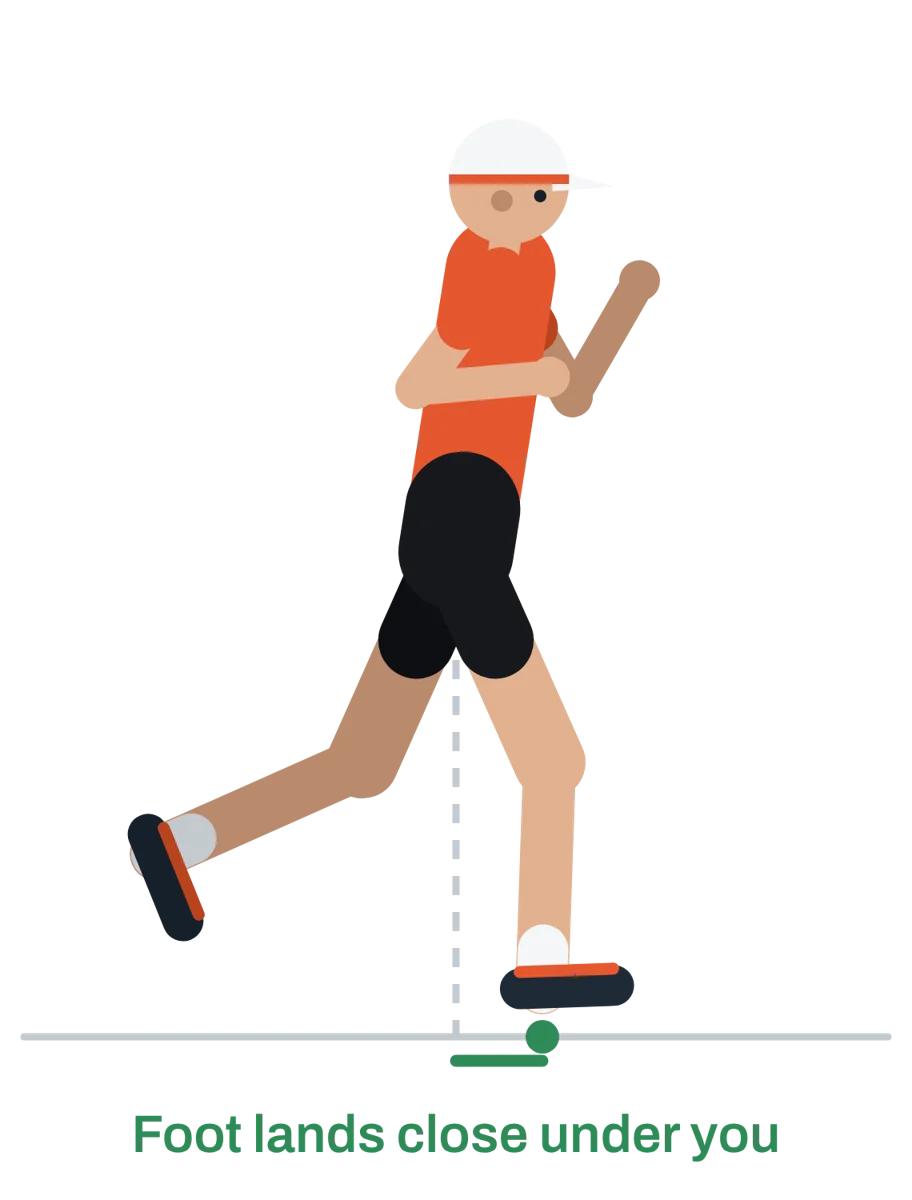
- Short, quick steps. Landing with your heel far out in front acts like a brake on every step.
- Tall and relaxed. Look ahead, shoulders down, arms swinging loosely.
- Any shoe that fits and feels comfortable. A 2022 Cochrane review found no good evidence that choosing shoes by foot type prevents injuries.
What is normal and what is not
| You notice | What to do |
|---|---|
| Muscles sore 1–2 days later | Normal in the first weeks. Easy walking helps; it fades within a few days. |
| Sharp pain under the ribs during a run | A side stitch. Walk, breathe out deeply, press on the spot. |
| Ache along the inner shin | Repeat or drop back a week and keep your rest days. See a professional if one small spot hurts to press, or it hurts at rest or at night. |
| Pain that makes you limp, or keeps getting worse | Stop running and get it checked. |
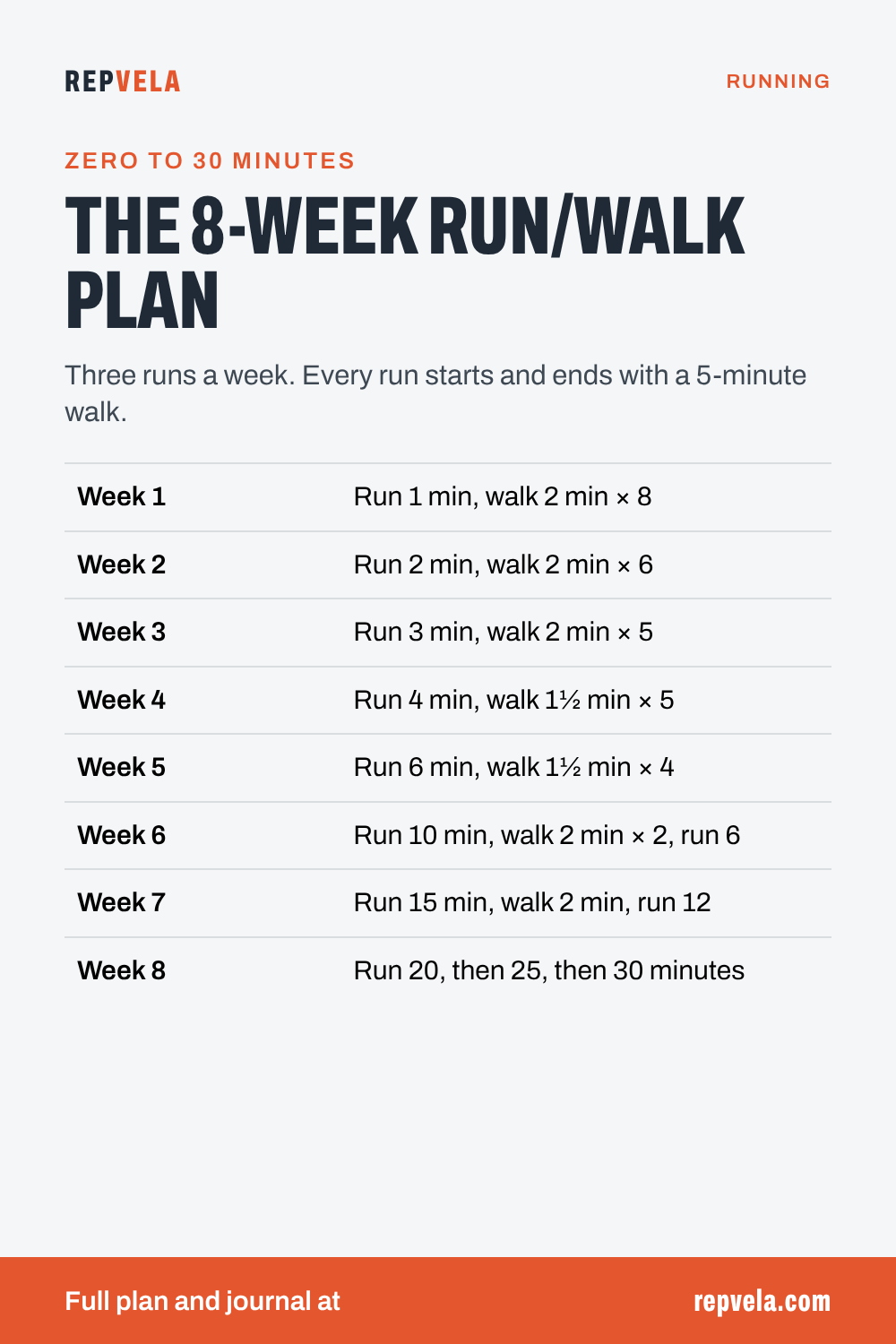
The full 8-week plan on one image, to save or print.
Save to PinterestStart Running
This plan is chapter 4 of the guide. The rest makes it work for you: what to do when something aches, a 10-minute strength routine, warm-ups and what to do after week 8.
Questions beginners ask
How long does it take a beginner to run 30 minutes?
About eight weeks on this plan, often 9–11 if you repeat a week or two, which is normal and sensible.
How fast should a beginner run?
Slowly enough to talk in full sentences. For most beginners that is barely faster than a brisk walk, and that is fine.
Can I run every day as a beginner?
Not at first. Three runs a week with a rest day between them gives your tendons and bones time to adapt. Walking, cycling or swimming on rest days is fine.
Is this the same as Couch to 5K?
It uses the same run/walk idea and also builds to about 30 minutes of running, which is around 4–5 km at an easy beginner pace.
What if I feel pain?
Mild muscle soreness a day or two later is normal. Pain that makes you limp, gets worse during a run, or hurts at rest or at night is a reason to stop and get it checked.
More beginner tips
Sources
- Frandsen JSB, Hulme A, Parner ET, et al. How much running is too much? Identifying high-risk running sessions in a 5200-person cohort study. British Journal of Sports Medicine, 2025;59:1203–1210.
- Relph N, et al. Running shoes for preventing lower limb running injuries in adults. Cochrane Database of Systematic Reviews, 2022;8:CD013368.
- Bok D, Rakovac M, Foster C. An examination and critique of subjective methods to determine exercise intensity: the Talk Test, Feeling Scale, and Rating of Perceived Exertion. Sports Medicine, 2022;52(9):2085–2109.
- Repvela, Start Running: The Complete Beginner's Guide, chapter 4.
This article is general information for healthy beginners, not medical advice. If something hurts sharply, keeps getting worse or does not settle, see a doctor or physiotherapist.