How to breathe in freestyle (for adult beginners)
If you are fit but gasping after one length, breathing is almost always the reason, not strength. The fix is simple to learn and changes everything: breathe out underwater, so that when you turn you only have to breathe in.
Breathe out slowly through your nose and mouth the whole time your face is in the water. To breathe in, turn your head to the side with your body roll, keeping one goggle in the water, take a quick breath through your mouth and turn your face back. Do not lift your head forward and do not hold your breath.
Why you run out of breath
Most beginners hold their breath with their face in the water. Then, in the half-second the mouth is clear, they try to breathe out and in. There is not enough time, so each breath is a little smaller than the last, and after a length you are gasping. Holding your breath also makes you tense, which makes you sink.
Learn it in five steps
- Bubbles at the wallHold the wall, put your face in and breathe out slowly through your nose and mouth. Humming helps. Lift, breathe in, repeat 10 times.
- Turn, do not liftTurn your head to the side with your body roll, keeping one goggle in the water. Lifting your head forward makes your hips and legs sink.
- Breathe in quicklyA short, relaxed breath in through your mouth, then put your face back and keep breathing out.
- Pick a patternBreathing every 2 strokes (always the same side) is easiest at first. Every 3 strokes (alternating sides) balances your stroke. Use whatever keeps you calm.
- Practise with a boardHold a kickboard with one hand, kick, and turn your head to breathe to the side. Add arms when it feels easy.
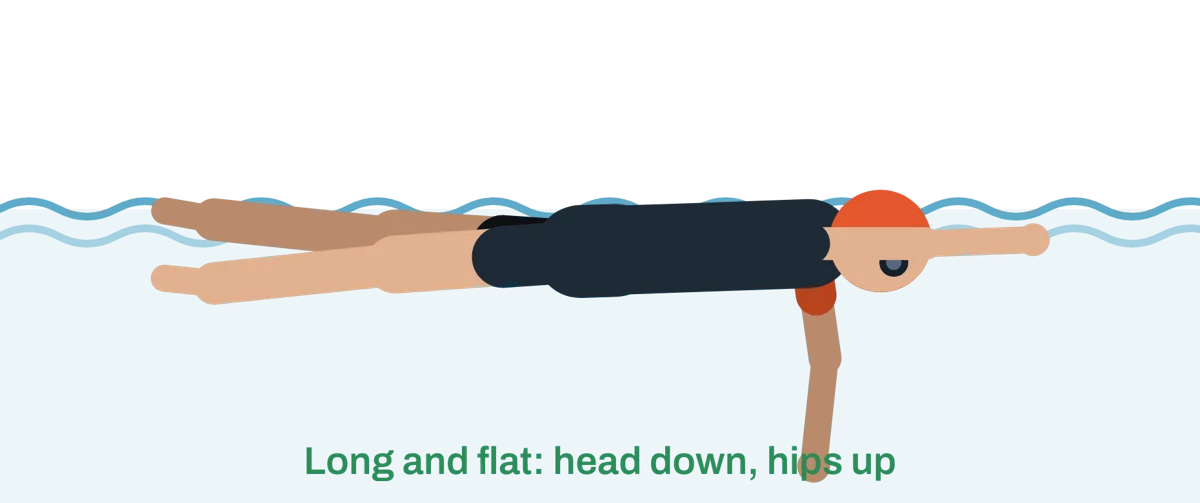
Timing the breath with your arms
Breathe to the side as the arm on that side pulls back past your hip. Return your face to the water as that arm swings forward. Counting "one, two, breathe" helps. If it all feels rushed, use the catch-up drill: wait until one hand touches the other in front before starting the next stroke. It slows everything down and gives you time to breathe.
Turn a little further with your body roll, and breathe in only when your mouth is clear. A strong final puff out just before you turn clears the water from around your mouth.
Common mistakes and fixes
| Mistake | What happens | Fix |
|---|---|---|
| Holding your breath | Breathless after a few strokes | Breathe out underwater the whole time your face is in |
| Lifting the head to breathe | Hips and legs sink | Turn to the side, one goggle in the water |
| Looking forward | Legs drop | Look at the bottom of the pool |
| Water up the nose | Stinging, coughing | Hum out gently through your nose underwater, or use a nose clip while you learn |
| Rushing the strokes | Short, splashy, tiring | Slow down; catch-up drill; reach long |
Five drills to start each session
For your first few weeks, spend 5 minutes on these before swimming lengths: bubbles at the wall, push and glide, kick with a board, side breathing with a board, and the catch-up drill.
Stop at the wall or stand up. Breathe out slowly, then in, until you feel calm. It is normal at first and fades quickly once breathing out underwater becomes automatic.
A 2024 systematic review of deaths in swimming listed deliberate underwater breath-holding as a risk. Never do breath-holding games, or deep, fast breathing before swimming underwater.
Yao et al., BMC Sports Science, Medicine and Rehabilitation, 2024.
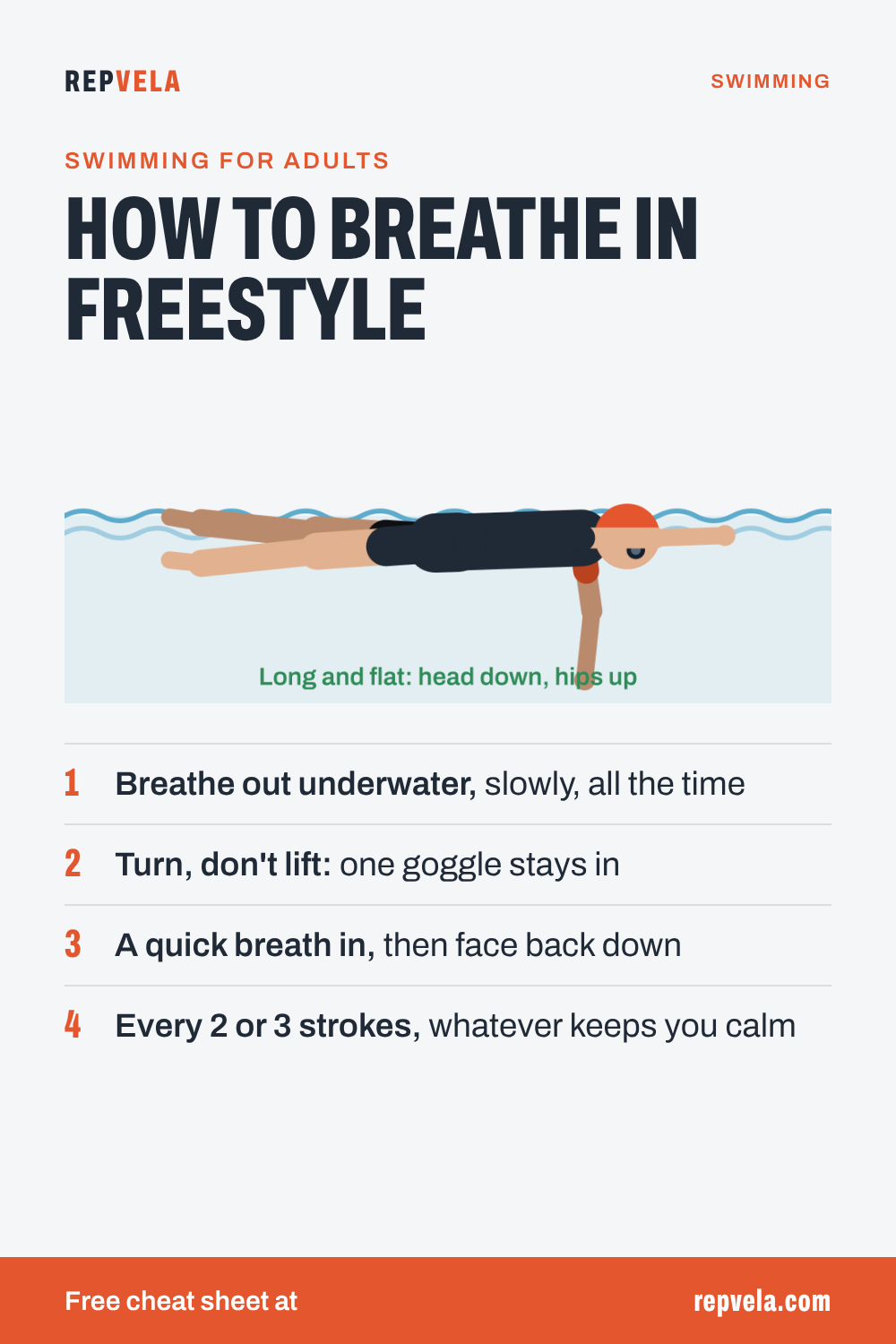
Breathe out underwater, turn, sip, repeat. The whole method on one image.
Save to PinterestStart Swimming
Breathing is chapter 4. The guide then walks you through freestyle step by step, with an 8-week plan from single lengths to 20 minutes non-stop, pool etiquette and water safety.
Questions beginners ask
Should I breathe through my nose or mouth when swimming?
Breathe out through your nose and mouth underwater, and breathe in quickly through your mouth when you turn.
How often should I breathe in freestyle?
Every 2 strokes is easiest when you start. Every 3 strokes, alternating sides, balances your stroke. Choose whatever keeps you calm and relaxed.
Why do I get so tired after one length?
Usually because you are holding your breath and kicking hard. Breathe out all the time your face is in, slow down, and kick small from the hips.
Why do my legs sink when I breathe?
You are lifting your head forward to breathe. Turn your head to the side instead, with one goggle still in the water.
Is it OK to use a nose clip?
Yes, while you learn. Many swimmers later drop it once humming out through the nose becomes a habit.
More beginner tips
Sources
- How to stop swallowing water while you're swimming, U.S. Masters Swimming.
- Yao Y, DiNenna MA, Chen L, et al. Hypothesized mechanisms of death in swimming: a systematic review. BMC Sports Science, Medicine and Rehabilitation, 2024;16:6.
- Repvela, Start Swimming: The Complete Beginner's Guide, chapters 4 and 5.
This article is general information for healthy beginners, not medical advice. If something hurts sharply, keeps getting worse or does not settle, see a doctor or physiotherapist.