Tennis scoring explained for beginners
Tennis scoring looks odd at first, but it has only three layers: points make a game, games make a set, sets make a match. Here is each one, in the order you need it on court.
Points go love (0), 15, 30, 40, game, and the server's score is said first. At 40–40 ("deuce") you must win two points in a row. The first to six games, at least two ahead, wins the set. At 6–6 you play a tiebreak: first to 7 points, two clear.
Points: love, 15, 30, 40, game
| Points won | Called |
|---|---|
| 0 | Love |
| 1 | 15 |
| 2 | 30 |
| 3 | 40 |
| 4 | Game (if you are two points ahead) |
The server's score is always said first. "30–15" means the server has won two points and the receiver one. "15–30" means the receiver is ahead. When the scores are level you say "all": "15-all", "30-all".
Deuce and advantage
At 40–40 the score is called deuce. You now need to win two points in a row:
- Win the next point and you have advantage ("advantage server" or "advantage receiver").
- Win the point after that and you win the game.
- Lose it, and you are back to deuce.
Some clubs and leagues skip advantage. At deuce one deciding point is played, and the receiver chooses which side to receive from. Agree the format before you start.
A worked example
Anna serves. She wins the first point (15–love), loses the next (15-all), wins two (40–15), then loses two (deuce). She wins the next point (advantage Anna), loses it (deuce), then wins two in a row: advantage Anna, game Anna.
Games and sets
A set is won by the first player to win six games, with at least a two-game lead: 6–4 wins, 6–5 does not. At 6–5 you play on: 7–5 wins the set. At 6–6 most matches play a tiebreak. Most matches are best of three sets.
The tiebreak
- Count normallyPoints go 1, 2, 3 and so on. First to 7 points, at least two ahead, wins the tiebreak and the set 7–6.
- Who servesThe player due to serve serves the first point. Then the opponent serves the next two, and after that players serve two points each.
- Change ends every 6 pointsFor example at 4–2 or 3–3.
- After the tiebreakThe player who received first in the tiebreak serves the first game of the next set.
Serving and changing ends
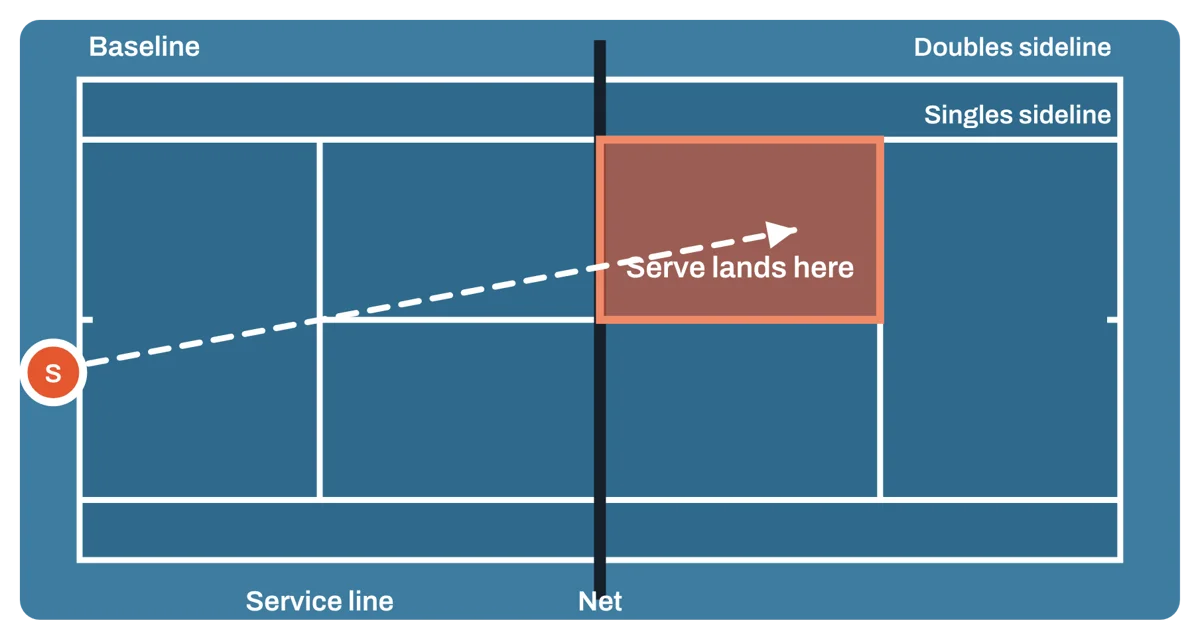
- One player serves a whole game. Start from the right of the centre mark, then alternate sides every point.
- Two tries. Miss both and you lose the point (a double fault). A serve that clips the net and lands in is a let and is replayed.
- Change ends after the first game, then after every two games (the odd-numbered games: 1, 3, 5…).
- A ball touching any part of the line is in.
Before every serve, call the score, server's first, loud enough for your opponent to hear. It prevents almost every argument.
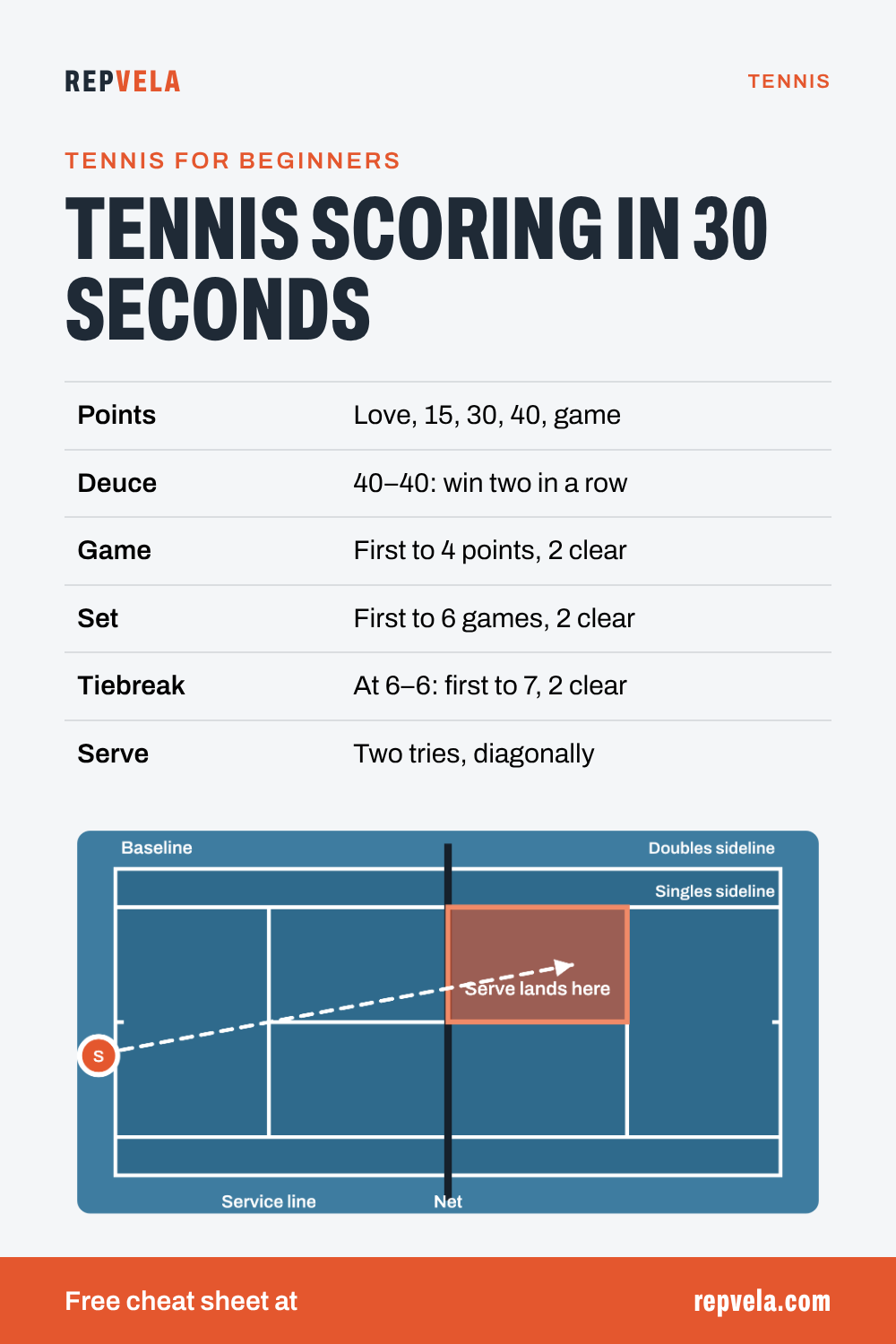
Points, deuce, sets and the tiebreak on one image.
Save to PinterestStart Playing Tennis
Scoring is chapter 6. The guide also covers choosing a racket and grip size, the forehand, backhand, volley and serve, an 8-week plan and how to avoid tennis elbow.
Questions beginners ask
Why does tennis scoring go 15, 30, 40?
Nobody knows for certain. The most common story is that scores were once kept on a clock face (15, 30, 45) and 45 was shortened to 40. What matters on court is simply that 40 means three points.
What does love mean in tennis?
Zero. "30–love" means the server has two points and the receiver none.
What is deuce?
40–40. From deuce a player must win two points in a row to win the game: advantage, then game.
How does a tiebreak work?
At 6–6 in a set, count points 1, 2, 3. The first to 7, at least two ahead, wins. The first server serves one point, then players serve two points each, changing ends every six points.
Is a ball on the line in or out?
In. A ball touching any part of the line counts as in.
More beginner tips
Sources
- ITF Rules of Tennis 2026, International Tennis Federation: rules 5 (score in a game), 6 (score in a set), 10 (change of ends), 12 (ball touching a line) and Appendix VI (no-ad).
- Repvela, Start Playing Tennis: The Complete Beginner's Guide, chapter 6.
This article is general information for healthy beginners, not medical advice. If something hurts sharply, keeps getting worse or does not settle, see a doctor or physiotherapist.